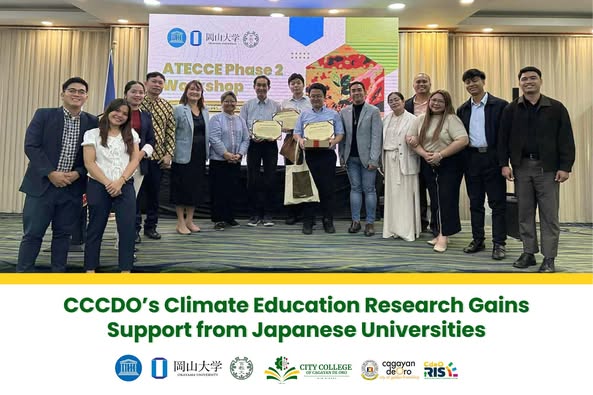
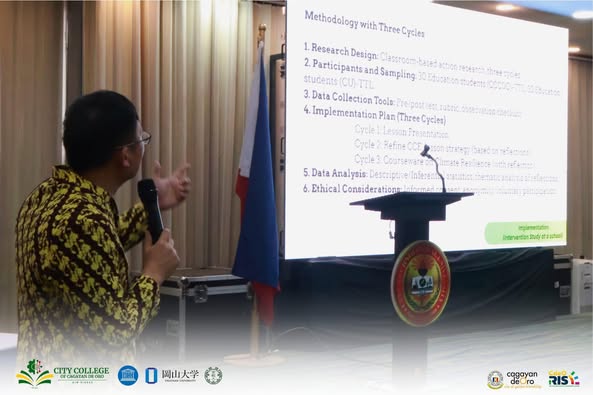
Cebu City, Philippines — City College of Cagayan de Oro (CCCDO) proudly unveiled two research projects on climate change education that have been selected for co-funding and support by Okayama University and the Miyagi University of Education in Japan. Representing Mindanao 1 and Mindanao 2, the studies were formally presented during the ATECCE 2 Project Philippine leg, held at Cebu Technological University, Cebu City, on September 15–17, 2025. The first study under Mindanao 1 is titled “The Tricycle Approach to Climate Change Education: Students’ Learning and Engagement through Contextualized Lesson Plans.” Led by Dr. Joel Potane of CCCDO with co-lead Dr. Amor de Torres of Capitol University, together with team members Ma. Aira Chenessa Aguilar, Hope Cariño, Janice Calapiz, and Eldin Camposo, the research examines how contextualized lesson plans can transform students’ understanding and engagement in climate change education. Conducted through a three-cycle implementation, the study investigates how learners’ grasp of climate concepts changes across cycles, how their engagement develops over time, and what refinements in lesson plan design contribute most to improved learning and participation. By emphasizing contextualization and iteration, the project underscores the importance of localized pedagogy in enhancing climate literacy in Northern Mindanao. The second study, representing Mindanao 2, is titled “Eco Librium and Climate Resilience Courseware as Game-Based Pedagogy for Climate Change Education: A Bicycle Model Approach among Grade 10 Learners in Mindanao.”
This initiative is spearheaded by Dr. Jestoni P. Babia, College President of CCCDO, with Dr. Donna Grace Cotejo as assistant lead and supported by team members Fhel Feliciano, Eugene Ranoco, and Sitti Aliah Paki. Drawing inspiration from the internationally recognized Bicycle Model of Climate Change Education, the study introduces innovative coursewares invented by the City College of CDO Technology Innovations and Data Management Center (TIDMAC) team, that uses gamification and interactive approaches to foster not only knowledge but also values, motivation, hope, and action competence among learners. By merging science with engaging pedagogy, the project aims to shape students into both climate-competent and climate-hearted individuals who can actively contribute to resilience-building in their communities. The support of Okayama University and the Miyagi University of Education highlights the global significance of these two Mindanao-based projects. Their presentation at ATECCE 2 also demonstrates the crucial role of international collaboration in advancing education for sustainable development. According to the CCCDO research teams, these initiatives show that when education is localized, innovative, and collaborative, it equips young people to become proactive stewards of climate resilience.
Despite being one of the Philippines’ youngest local colleges, CCCDO has rapidly positioned itself as a leader in sustainability-focused education and research.
The recognition and co-funding of these projects by Japanese universities serve as a strong affirmation that local institutions in Mindanao can drive educational innovation with global impact. For schools across the country, these studies send a compelling message: climate change education is no longer an option but an urgent priority, and bold partnerships can turn vision into meaningful
